

Most DeFi yield strategies are quietly long the market. The mechanics vary — liquidity provision, lending, staking — but the underlying exposure tends to be the same: when prices fall, returns compress or disappear entirely.
Market-neutral strategies are built on a different premise. The goal is to generate yield without taking a view on price direction. No long exposure, no short exposure — just a carefully constructed set of positions designed to produce returns regardless of what BTC or the broader market decides to do.
What market-neutral actually means in DeFi
A market-neutral strategy generates returns through mechanisms structurally independent of asset price movement — delta-neutral positions, stablecoin-denominated allocations, yield sources tied to protocol activity rather than price appreciation.
Realized returns don’t depend on being right about market direction. The strategy earns from spread, from protocol fees, from funding rates. This matters most in drawdown environments. When directional strategies are bleeding, market-neutral strategies continue operating on the same logic they always did.
The recent data
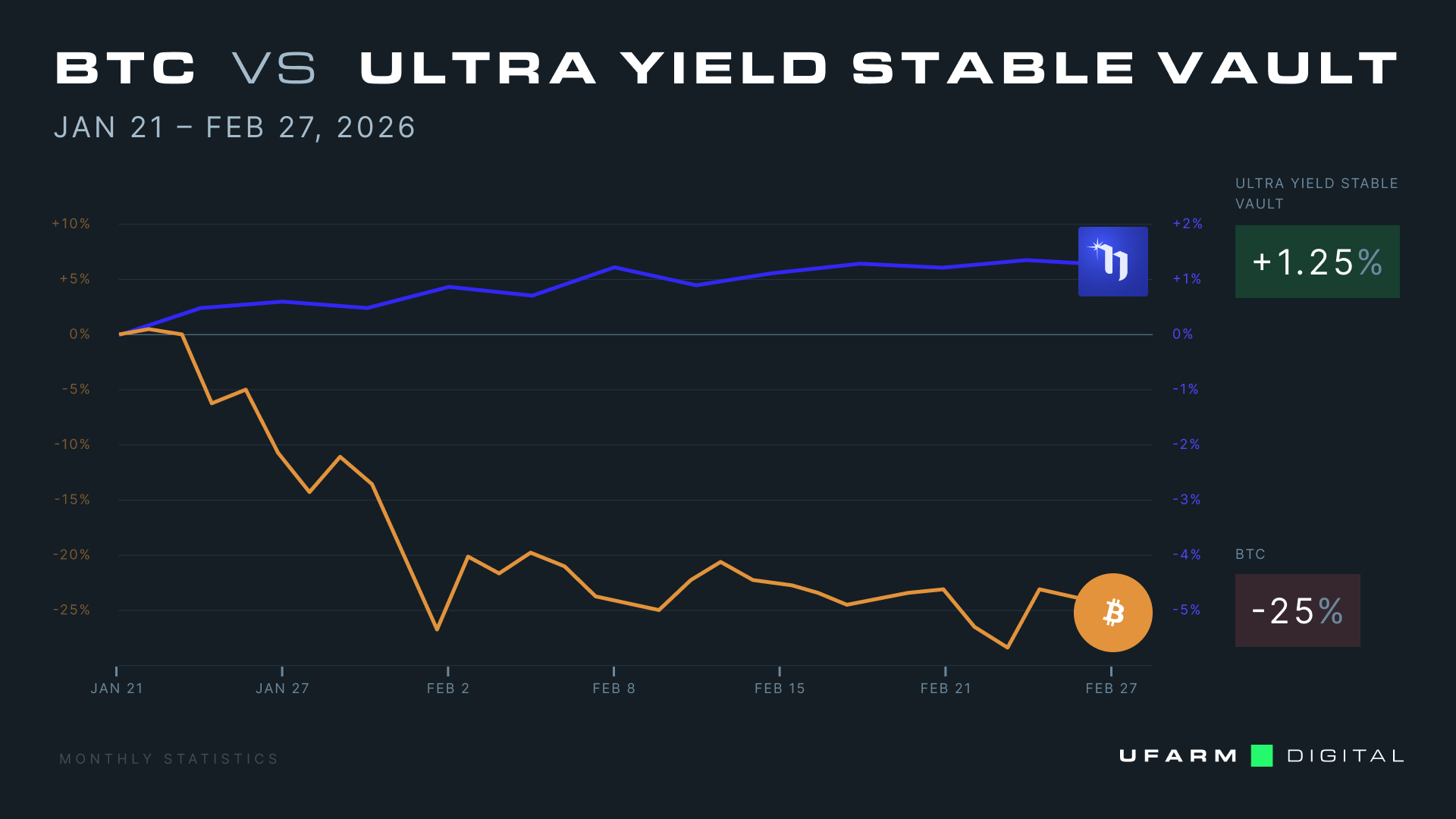
From January 21 to February 27, 2026, BTC fell 25%. Over the same period, the Ultra Yield Stable Vault — managed by Edge Capital on UFarm.Digital — returned +1.25%.
That’s not an anomaly. The vault deploys USDC and USDT across curated DeFi protocols, rebalancing allocations to maintain consistent yield without directional exposure. The 26-percentage-point gap over five weeks illustrates the core value proposition: in a down market, the absence of directional exposure is itself a source of alpha.
How UFarm.Digital fits into this
UFarm is a non-custodial asset management protocol on Arbitrum and Ethereum. Professional managers operate onchain vaults that are transparent, audited, and fully non-custodial. The investor retains custody through vault tokens representing their share of the pool — no intermediary holds funds, every allocation is visible onchain.
For market-neutral strategies specifically, this architecture matters. Investors can verify that the vault holds what it claims, runs the strategy it describes, and generates the yield it reports — without trusting a black box.
DeFi has a reputation for being a leveraged bet on prices going up. For most protocols, that reputation is earned. Market-neutral vaults managed by verified professionals, operating through audited non-custodial infrastructure, are a different category entirely — and the past five weeks of data make that case without much elaboration needed.