
When evaluating a DeFi protocol, one number appears consistently across dashboards, research reports, and protocol pages: TVL. It is the most widely used metric in decentralised finance — and one of the most frequently misread.
What TVL means
Total Value Locked is the aggregate fiat value of all assets currently deposited into a DeFi protocol’s smart contracts. When a user deposits tokens into a lending market, a liquidity pool, or a yield vault, the value of those tokens contributes to the protocol’s TVL.
The calculation is straightforward: take the quantity of each deposited asset, multiply by its current market price, and sum across the entire protocol. A protocol holding 10,000 tokens priced at $10 each has $100,000 in TVL from that asset alone.
Because smart contracts cannot access external price data natively, protocols rely on oracle networks to fetch real-time market prices. This infrastructure is what makes TVL calculations accurate and manipulation-resistant.
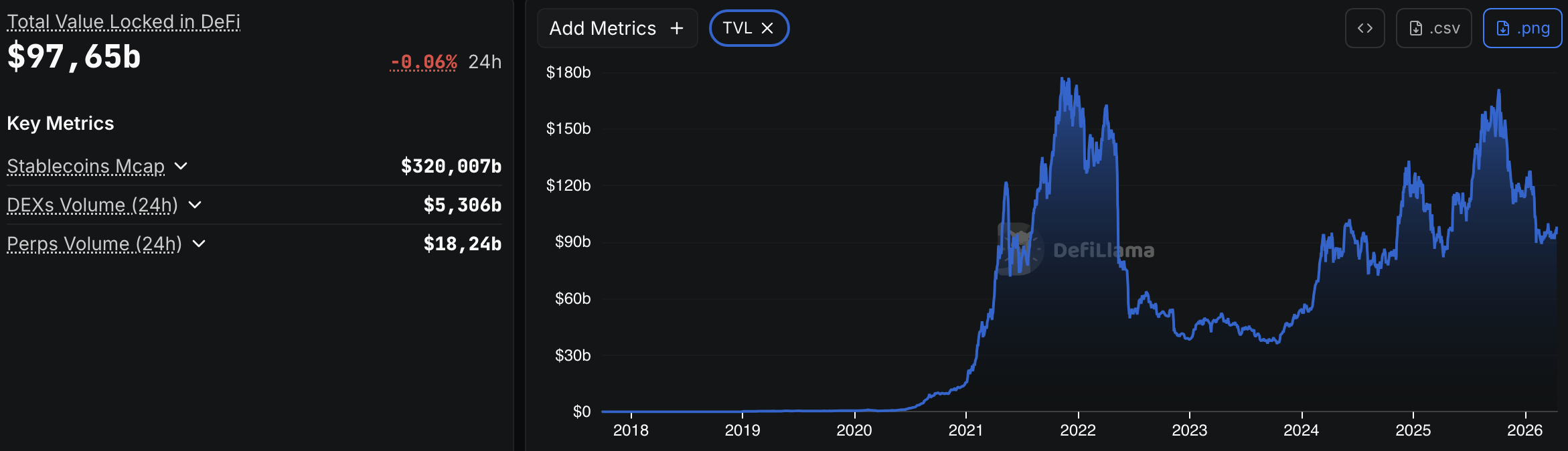
Total Value Locked in DeFi (Apr 16)
What TVL signals
TVL is primarily a measure of capital confidence. When users and institutions deposit assets into a protocol’s smart contracts, they are demonstrating trust in its security and economic model. High TVL generally indicates strong adoption, deep liquidity, and a protocol that has been stress-tested by real capital.
For lending protocols, TVL determines whether borrowers can access funds and lenders can withdraw when needed. For decentralised exchanges, TVL defines liquidity depth — insufficient TVL means large trades cause significant price slippage. For yield vaults like those on UFarm.Digital, TVL reflects how much capital professional managers are actively deploying across strategies.
TVL also has a compounding effect. As more capital enters a protocol, deeper liquidity attracts more users, which attracts more capital. This is why early TVL growth is a meaningful signal of protocol momentum.
What TVL does not tell you
TVL has real limitations that are worth understanding before using it as the sole basis for evaluating a protocol.
Price sensitivity. TVL is denominated in fiat, which means it moves with token prices even when no new capital enters or exits. A protocol’s TVL can double during a bull market without a single new deposit, and collapse during a downturn without a single withdrawal. Tracking the underlying token quantity alongside the fiat valuation gives a more accurate picture of actual usage.
Double counting. DeFi is composable — assets frequently move across multiple protocols simultaneously. A user might deposit into a lending protocol, receive a receipt token, and deposit that into a separate vault. Both protocols count the same underlying value in their TVL, inflating aggregate industry figures.
No measure of returns. TVL tells you how much capital is in a protocol, not how well it is performing. A high-TVL protocol with poor yield generation or high fees may be less attractive than a smaller protocol with superior risk-adjusted returns.
TVL and the TVL ratio
Market participants sometimes compare a protocol’s market capitalisation to its TVL to assess relative valuation. A ratio above 1.0 means the protocol’s native token is valued higher than the capital it holds — potentially indicating speculative premium. A ratio below 1.0 suggests the protocol holds more capital than its token’s market value reflects, which can indicate strong fundamental usage relative to token price.
This ratio is a useful starting point, not a definitive signal. Context matters: a protocol in early growth may carry a higher ratio legitimately, while a mature protocol with a low ratio may have structural issues not visible in the TVL figure alone.
The bottom line
TVL is the standard starting point for evaluating DeFi protocols — a measure of capital confidence, liquidity depth, and adoption. Used in isolation, it can mislead. Used alongside yield performance, audit coverage, risk profiles, and manager track records, it becomes a meaningful part of a complete picture.
For anyone depositing into DeFi vaults, understanding what TVL reflects — and what it does not — is a foundational step toward making informed allocation decisions.
→ Explore vaults on UFarm.Digital.